
- In 122,007 adults undergoing treadmill testing, low fitness carried a mortality hazard ratio of 5.04 compared with elite fitness.
- Across more than 750,000 veterans, each 1-MET increase in fitness was associated with a 13–15% lower mortality risk.
- Any resistance training reduced all-cause mortality risk by about 15%, with a maximum reduction near 27% at roughly 60 minutes per week.
- In one analysis of 398,716 people, good cardiorespiratory fitness was associated with no significant excess mortality regardless of BMI.
- These are the highest-leverage numbers in preventive medicine, and both are trainable at any age.
The most underused test in medicine
If you could measure one thing to estimate how long someone will live and how well they will function, it would not be cholesterol, blood pressure, or body weight. It would be cardiorespiratory fitness — VO2 max, the maximum rate at which your body can take in and use oxygen. It integrates cardiac output, pulmonary function, vascular health, mitochondrial density and skeletal muscle capacity into a single number. And it is measured far less often than any of the markers it outperforms.
What the cohort data actually shows
The Cleveland Clinic analysed 122,007 consecutive adults referred for symptom-limited treadmill testing, with a median follow-up of 8.4 years. Compared with the elite fitness group, patients in the low-fitness group had an adjusted hazard ratio for all-cause mortality of 5.04. Being below average rather than above average carried a hazard ratio of 1.41. Crucially, the benefit did not plateau at a moderate level — survival kept improving into the highest fitness categories, and the authors noted that reduced fitness carried risk comparable to major established risk factors.
The dose-response is remarkably clean
A subsequent analysis of more than 750,000 United States veterans — the largest cardiorespiratory fitness dataset assembled — found that each one-MET increase in fitness, roughly 3.5 ml/kg/min of VO2 max, was associated with a 13 to 15 percent reduction in mortality risk. That association held across age, body mass index, sex and comorbidity. No group was too old or too deconditioned to benefit. This is an unusually consistent finding in an epidemiological literature that is often anything but.
Strength is the second axis
Aerobic fitness is not the whole story. A systematic review and meta-analysis in the American Journal of Preventive Medicine found that any amount of resistance training was associated with a 15 percent lower risk of all-cause mortality, with a dose-response analysis suggesting a maximum risk reduction of around 27 percent at approximately 60 minutes per week. Notably, benefit diminished at higher volumes. Sixty minutes a week is two or three short sessions. That is a genuinely achievable prescription, and it is roughly where the curve bottoms out.
Fitness versus body weight
One of the more useful findings for patients who feel defeated by the scale: in an analysis of 398,716 individuals, people with good cardiorespiratory fitness showed no significant increase in mortality risk regardless of body mass index, for both cardiovascular and all-cause mortality. This does not mean body composition is irrelevant — visceral fat drives metabolic disease through mechanisms fitness does not fully offset. It does mean that if you have to choose where to spend your effort first, training capacity is a better target than a number on a scale.
How we measure and track it
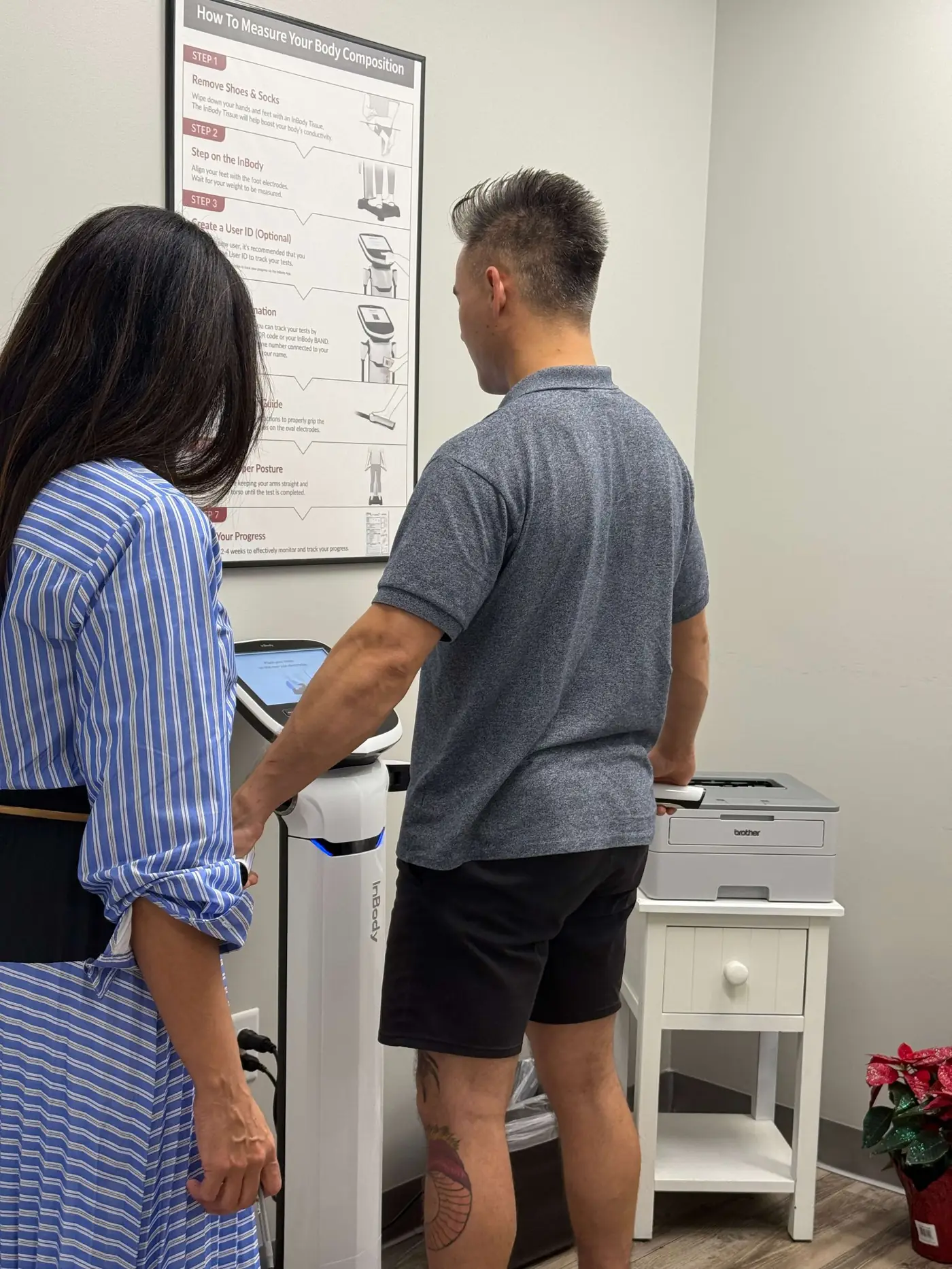
Estimated VO2 max from a wearable is a reasonable starting point and adequate for tracking direction over time. Formal testing gives a better number and a better prescription. Alongside it we look at grip strength, which independently predicts mortality across very large cohorts and takes thirty seconds to measure, and body composition, because preserving lean mass is what keeps function intact through later decades. These sit next to your labs in the same review, not in a separate conversation.
What a plan looks like
For most adults: three to four sessions per week of zone-two aerobic work, one shorter high-intensity session, and two resistance sessions covering the major movement patterns with progressive load. Protein intake sufficient to support that training. Enough sleep to recover from it. Where indicated, we address the medical obstacles that make training hard — untreated hypothyroidism, iron deficiency, poorly managed blood pressure, joint pain, sleep apnoea. That last category is where a physician adds something a trainer cannot, and it is often what has been blocking progress for years.
The honest caveats
Almost all of this evidence is observational. Fitter people differ from less fit people in many ways beyond fitness, and reverse causation is a genuine concern — illness reduces fitness as well as the other way round. The best studies address this by excluding early deaths and adjusting extensively, and the associations survive. Still, the correct framing is that fitness is strongly and consistently associated with survival, not that a specific VO2 max guarantees a specific lifespan. Anyone promising the latter is selling something.
What the research says
We cite the studies directly, including where the evidence is thin. Every link goes to the primary source.
The increase in all-cause mortality associated with reduced cardiorespiratory fitness (low vs elite: adjusted HR, 5.04; 95% CI, 4.10-6.20; P < .001) was comparable [to major risk factors].
Mandsager K, et al. Association of Cardiorespiratory Fitness With Long-term Mortality Among Adults Undergoing Exercise Treadmill Testing. JAMA Network Open, 2018.
122,007 consecutive patients, median follow-up 8.4 years. Survival benefit continued to increase into the highest fitness category with no observed upper limit.
A maximum risk reduction of 27% was observed at around 60 minutes per week of resistance training (RR=0.74; 95% CI=0.64, 0.86). Mortality risk reductions diminished at higher volumes.
Shailendra P, et al. Resistance Training and Mortality Risk: A Systematic Review and Meta-Analysis. American Journal of Preventive Medicine, 2022.
Ten studies pooled. Any resistance training was associated with 15% lower all-cause mortality; the dose-response curve bottoms out at an achievable weekly volume.
In the multivariable model with Vo2max as a continuous variable, a 1–ml/(kg · min) increase in Vo2max was associated with an estimated 30-day increase in life expectancy.
Midlife Cardiorespiratory Fitness and the Long-Term Risk of Mortality: 46 Years of Follow-Up. Journal of the American College of Cardiology, 2018.
Forty-six years of follow-up, with early deaths excluded to limit reverse causation. The estimates were essentially unchanged, which is the strongest available argument against confounding by illness.
Frequently asked questions
Do I need a formal VO2 max test?+
Not to begin. A wearable estimate is adequate for tracking direction. Formal testing gives a more precise number and a better training prescription, and is worth it if you are optimising seriously.
I'm in my sixties. Is it too late?+
No. In the largest fitness cohort assembled, the mortality benefit per unit of fitness held across age groups. No group was too old to benefit.
How much training does this require?+
Roughly three to four aerobic sessions and two resistance sessions per week. The resistance dose-response suggests about 60 minutes weekly captures most of the benefit.
Is more always better?+
For aerobic fitness the survival curve kept improving in the largest cohorts. For resistance training, benefit diminished above roughly an hour a week.
Does this replace managing cholesterol and blood pressure?+
No. Fitness is additive to risk-factor management, not a substitute for it.
Why measure grip strength?+
It is a fast, reproducible proxy for whole-body strength that independently predicts mortality across cohorts totalling millions of participants.
What if pain or fatigue stops me training?+
That is a medical problem worth solving. Untreated thyroid disease, iron deficiency, sleep apnoea and unmanaged joint pain are common and treatable obstacles.
Can I trust my watch's VO2 max estimate?+
As a trend, largely yes. As an absolute number, treat it as approximate.


When your health works better, everything does.
Tell us about your goals, your challenges, and what matters most to you — we'll take it from there.
Let's talk