Skip to content

Diagnostics

Advanced Lab & Biomarker Testing

Advanced lab testing looks beyond standard panels, adding hormones, inflammation, metabolic and cardiovascular markers and nutrient status, and every result is interpreted by your physician into a clear, prioritized plan. It is for adults with persistent symptoms despite normal routine labs and for those focused on prevention. Testing is arranged at Organic Well in Coconut Grove, Miami; patients elsewhere in Florida can draw blood locally and review results by secure video.

In-clinic in Coconut Grove and via telehealth across Florida · (305) 930-8891

Medically reviewed by Dr. Elizabeth Isalguez Last reviewed

Key takeaways

  • A standard annual panel is built to detect disease, not to describe how well you are functioning. That is why “normal labs” and persistent symptoms so often coexist.
  • Advanced panels add lipoprotein particle data, insulin dynamics, inflammatory markers, full thyroid detail and nutrient status.
  • More markers only help when a physician reads them together, against your symptoms and your previous results.
  • Reference ranges describe the population that got tested, not your personal optimum; trends across repeat testing carry more weight than any single value.
  • A test is worth running only when the result could change what we do next.

What it supports

Deeper insight

A wider biomarker map than routine annual panels.

Root-cause focus

Patterns across markers point to causes, not just symptoms.

Clear next steps

Every review ends with a prioritized, written action plan.

What advanced lab testing covers

A standard annual panel is designed to screen for disease. It answers one question: is anything clearly wrong? For most healthy adults the answer is no. That is why so many people are told their labs are normal while still feeling depleted, foggy or flat.

Advanced testing widens the map. Depending on your history we may add lipoprotein particle number and ApoB, fasting insulin and HOMA-IR, hs-CRP and other inflammatory markers, a full thyroid panel rather than TSH alone, sex and adrenal hormones, iron studies, B12, folate, magnesium, vitamin D and omega-3 index. The aim is resolution, not volume: enough detail to explain a pattern rather than confirm the absence of disease.

How it works, step by step

  1. Consultation: symptoms, history, medications, family risk, and what you actually want to change.
  2. Panel selection: your physician chooses markers that could alter the plan, and explains why each one is on the list.
  3. Draw: fasting where required, at our Coconut Grove clinic or at a lab near you if you live elsewhere in Florida.
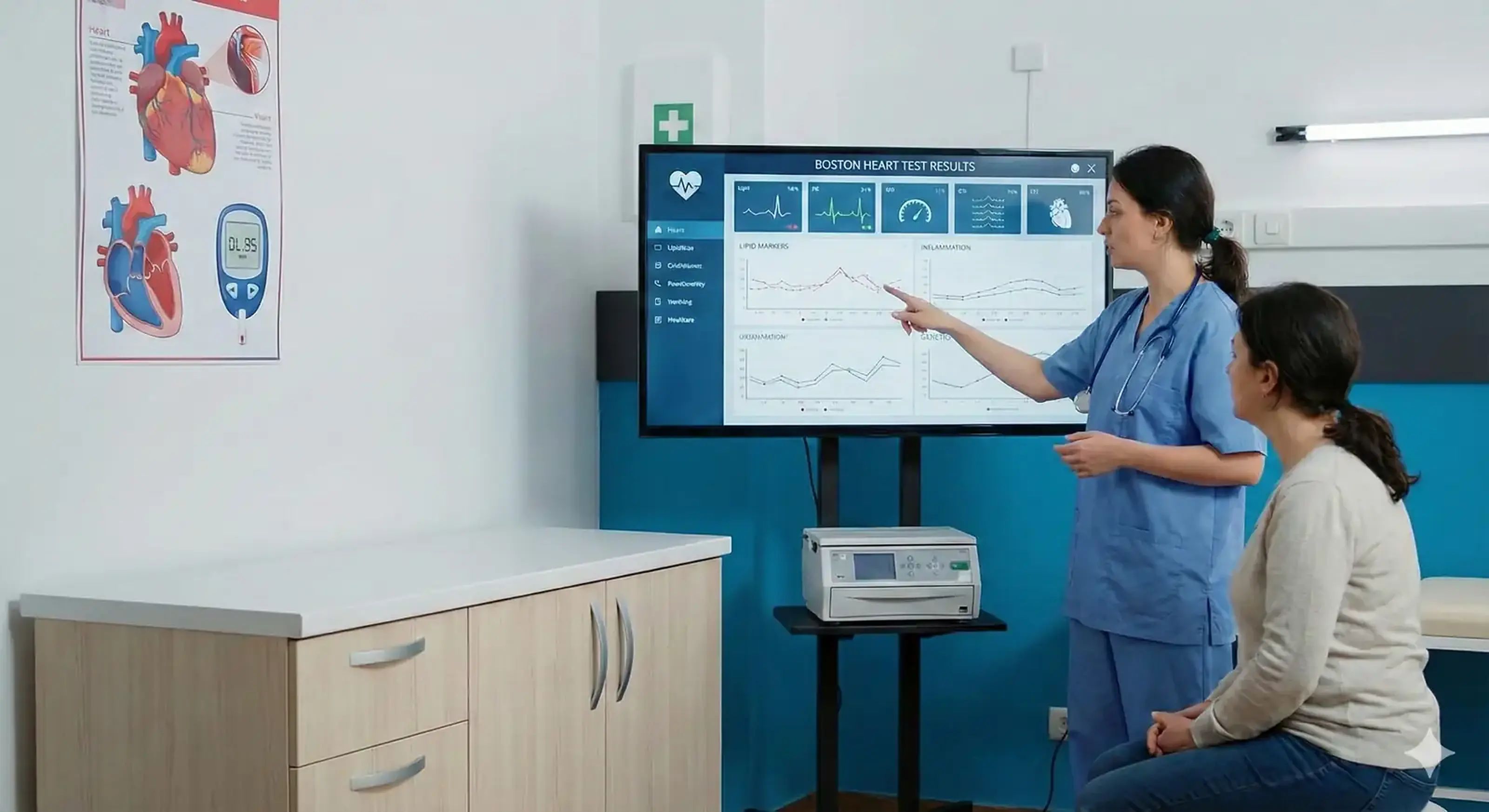
  4. Interpretation: results read together and in context, never marker by marker in isolation.
  5. Written plan: a prioritized summary of what matters now, what to watch, and when to retest.

Who it’s for, and who it isn’t

Likely a good fit: adults with persistent symptoms and unremarkable standard labs, anyone building a longevity baseline in their thirties to fifties, patients tracking response to hormone, metabolic or nutritional treatment, and people with a family history they want to get ahead of.

Likely not a fit: anyone hoping a panel will diagnose a condition on its own, patients who want testing without a clinical review attached, and anyone in acute illness. Results are distorted then, and urgent care comes first.

What to expect at your first visit

The first appointment is a consultation, not a blood draw. We take a full history, review any outside labs you bring, and agree together on which markers are worth running. Results are usually back within one to two weeks and are reviewed with you in a dedicated appointment. Nothing is sent as a PDF with no explanation attached.

Reading results honestly

A value outside the reference range is not automatically a problem, and a value inside it is not automatically fine. Ranges are statistical descriptions of the population that happened to be tested, and they shift with age, sex and laboratory method.

We also say when a marker is interesting but not yet actionable. Some advanced tests have strong outcome data behind them; others are early. We will tell you which is which rather than building a plan on a marker that has not earned it.

Pricing and insurance

Organic Well does not participate with insurance plans. Panel costs vary with what is ordered and are quoted before anything is drawn. We provide superbills you can submit for potential out-of-network reimbursement, and we will tell you plainly when a marker is not worth the money.

Advanced lab testing in Coconut Grove, Miami

Draws are done at 3661 S. Miami Ave, Suite 1003, minutes from Brickell, Coral Gables and downtown Miami. Patients elsewhere in Florida can have blood drawn locally and review results with their physician by secure video.

Further reading

Evidence

What the research says

Peer-reviewed sources, quoted directly, including where the evidence is thin.

  • Apolipoprotein B unifies, amplifies, and simplifies the information from the conventional lipid markers as to the atherogenic risk attributable to the apoB lipoproteins.

    Sniderman AD, Thanassoulis G, Glavinovic T, Navar AM, Pencina M, Catapano A, Ference BA. Apolipoprotein B Particles and Cardiovascular Disease: A Narrative Review. JAMA Cardiology, 2019.

    Every atherogenic particle carries exactly one apoB, so measuring apoB counts the particles rather than estimating the cholesterol inside them. A standard lipid panel can read reassuringly normal while particle count, and therefore risk, is not.

  • In this trial of apparently healthy persons without hyperlipidemia but with elevated high-sensitivity C-reactive protein levels, rosuvastatin significantly reduced the incidence of major cardiovascular events.

    Ridker PM et al. Rosuvastatin to Prevent Vascular Events in Men and Women with Elevated C-Reactive Protein. New England Journal of Medicine, 2008 (JUPITER).

    17,802 adults with LDL cholesterol under 130 mg/dL and hs-CRP of 2.0 mg/L or higher. Hazard ratio 0.56 (95% CI 0.46 to 0.69). A marker outside the standard panel identified people who benefited from treatment they would not otherwise have been offered.

  • General health checks are unlikely to be beneficial.

    Krogsbøll LT, Jørgensen KJ, Gøtzsche PC. General health checks in adults for reducing morbidity and mortality from disease. Cochrane Database of Systematic Reviews, 2019.

    17 randomized trials, 251,891 participants. No effect on total mortality (RR 1.00, 95% CI 0.97 to 1.03; high-certainty evidence). We include this deliberately: broad testing of unselected adults does not, by itself, extend life.

Our position

We order advanced panels for a reason, and the reason is never “more data”. Cochrane is right that screening an unselected population changes little. What changes outcomes is a test ordered because its result will change a decision: apoB when the standard panel looks fine but the risk picture does not, hs-CRP when it decides whether to treat, iron or thyroid studies when a symptom points there. If a result would not change what we do next, we do not order it, and we will tell you why.

Frequently asked questions

In-clinic in Coconut Grove and via telehealth across Florida · (305) 930-8891

Advanced lab testing includes specialized laboratory analysis that evaluates metabolism, hormones, inflammation, and nutrient status.

Functional medicine lab testing focuses on physiology and system function rather than disease diagnosis alone.

Not necessarily. Many patients use lab testing for prevention and health optimization.

Timing varies depending on the laboratory and type of testing.

Yes. Results are reviewed with a medical professional and integrated into a care plan.

Coverage depends on the type of testing and individual insurance plans.

Panels are broader and interpreted for optimization, not only disease screening: trends and optimal ranges, not just in range / out of range.

Many panels require fasting; our team confirms preparation instructions when your draw is scheduled.

Most results return within 1–2 weeks and are reviewed with your physician in a dedicated visit.

Contact

Request a consultation

Share a few details and our team will reach out within one business day.

Visit us

3661 S. Miami Ave, Suite 1003Miami, FL 33133 · United States By appointment · Mon–Fri, 9 AM – 6 PM

Your contact details

I'm interested in

Tell us about your goals

Thank you! Your submission has been received!
Oops! Something went wrong while submitting the form.