Why the route matters at all
Nutrients taken by mouth have to survive digestion. Absorption varies with gut health, gastric pH, the presence of food, competing minerals and the dose itself. For several nutrients the absorptive mechanism saturates, so a larger oral dose simply produces a larger unabsorbed fraction. Vitamin C is the textbook case: oral dosing raises plasma levels only modestly regardless of how much you take, because uptake is transporter-limited. Intravenous administration bypasses that ceiling entirely and reaches plasma concentrations oral supplementation cannot. That is a real pharmacological difference, and it is the legitimate argument for the route.
Where it genuinely helps
Used well, IV therapy does three things credibly. It rehydrates quickly, which matters after illness, heat exposure, travel or a hard training block. It corrects documented depletion faster than oral repletion in patients with malabsorption, post-surgical states, or intake that cannot keep up. And it delivers specific nutrients at concentrations that oral routes cannot reach, where there is a clinical reason to want that. Notice the qualifier running through all three: documented, clinical, specific. The best infusion is the one chosen from your labs and history.
Where the marketing outruns the evidence
The claims attached to IV drips (immunity, detoxification, anti-aging, hangover cures, general vitality) are not supported by large randomized trials. A review of clinical applications of intravenous vitamin therapy put it bluntly: these claims are widely publicized by celebrities and influencers and lack support from large-scale randomized controlled trials. The trials that do exist are mostly small, short, single-center, and heterogeneous in dose and formulation. Absence of high-quality evidence is not proof that something does nothing, but it is a reason to stop selling certainty.
The fatigue question
The most-cited positive trial is worth understanding precisely, because it is frequently misrepresented. A double-blind randomized controlled trial published in Nutrition Journal gave 141 healthy office workers aged 20 to 49 either 10 grams of intravenous vitamin C or saline, and reported reduced fatigue in the treatment group two hours after infusion. That is a genuine finding in a real trial. It is also a single infusion in healthy adults with a short follow-up window, which is a considerable distance from a claim that regular drips will fix chronic fatigue.
What an infusion cannot replace
No infusion substitutes for sleep, protein intake, training, alcohol reduction, or treatment of an underlying condition. When fatigue has a cause, such as hypothyroidism, iron deficiency, insulin resistance, sleep apnea, depression or medication side effects, the answer is finding it. This is the part of the conversation that distinguishes a medical practice from a drip lounge. A responsible clinician will sometimes tell you that IV therapy is the wrong tool for what you are describing, and will say what the right one is.
Safety, screening and honest risk
Infusions given by licensed clinical staff after a medical review have a good safety record. Common effects are minor: a cool sensation along the arm, a metallic taste, mild bruising, occasional lightheadedness. Less common risks include vein irritation, infiltration and allergic reaction. Screening genuinely matters: high-dose vitamin C is avoided in G6PD deficiency because of hemolysis risk, used cautiously in kidney impairment and in anyone with a history of calcium-oxalate stones, and total fluid volume needs care in heart failure. Tell your provider every medication and supplement you take. And to be explicit: IV therapy is not emergency care. If you are having chest pain or difficulty breathing, call 911.
What physician-guided actually means
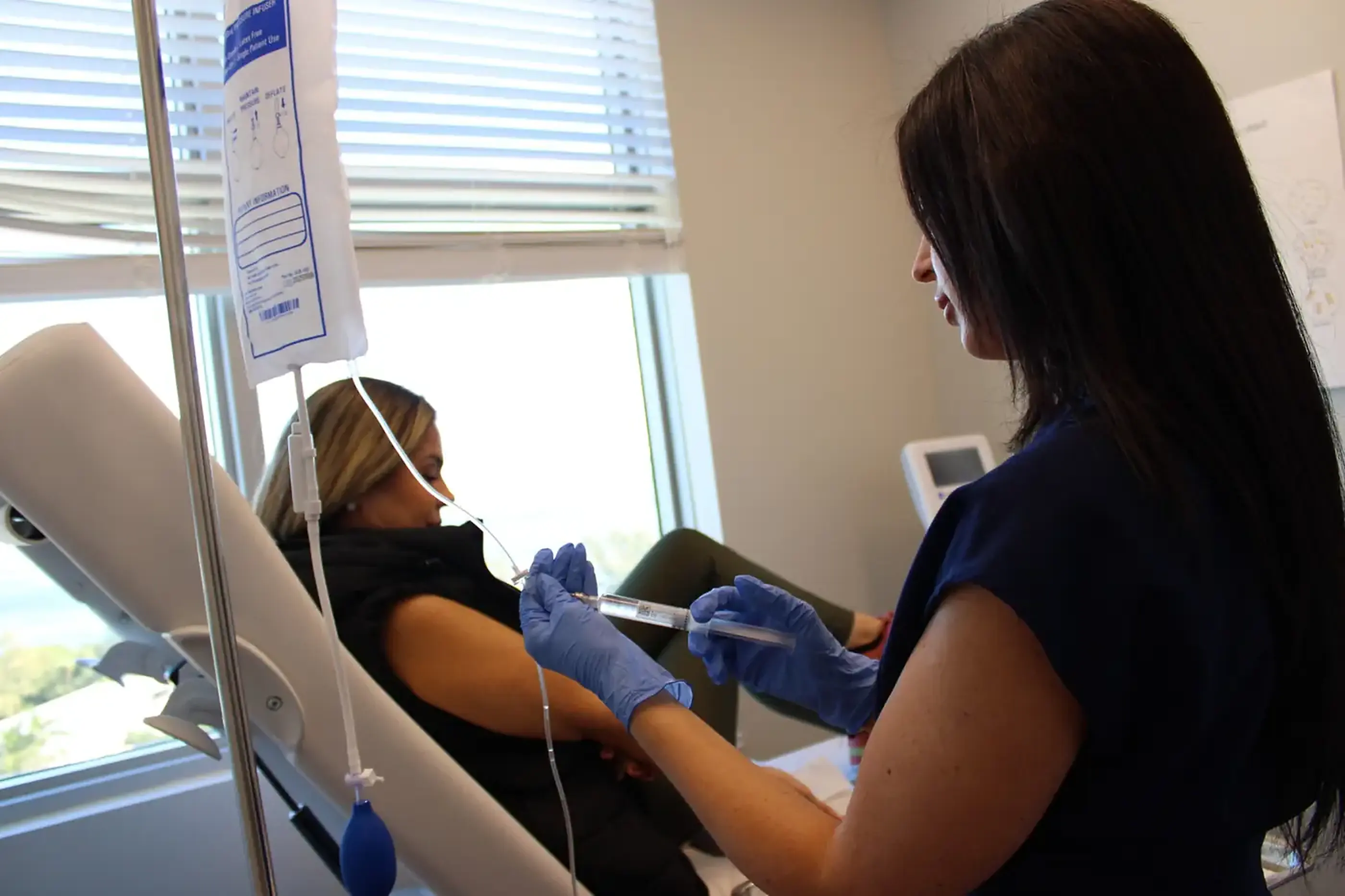
It means five specific things. A medical intake before anything is ordered. Labs where they change the decision. A formula selected by a licensed provider from those results rather than from a price list. Administration and monitoring by licensed clinical staff in a clinical setting. And follow-up that asks whether it is actually working, with a willingness to stop if the answer is no. That last step is the one most commonly missing, and it is the difference between a therapy and a subscription.
Evidence
What the research says
We cite the studies directly, including where the evidence is thin. Every link goes to the primary source.
A recent pharmacokinetic study of oral vitamin C showed that plasma vitamin C concentrations are little affected by oral administration, because of poor bioavailability.
Suh S-Y, et al. Intravenous vitamin C administration reduces fatigue in office workers: a double-blind randomized controlled trial. Nutrition Journal, 2012.
141 healthy adults aged 20–49 randomized to 10 g intravenous vitamin C or saline. Fatigue was lower in the treatment group two hours after infusion.
Given the low certainty of evidence, this potentially life-saving therapy warrants further studies to identify the optimal timing, dosage, treatment duration.
Lee Z-Y, et al. Intravenous vitamin C monotherapy in critically ill patients: a systematic review and meta-analysis of randomized controlled trials. Annals of Intensive Care, 2023.
Even in intensive care, where the research effort has been largest, dose and timing remain unsettled. Route alone does not determine benefit.
These claims, although widely publicized by celebrities and influencers, lack support from large-scale, randomized controlled trials.
The Science Behind Intravenous Vitamin Therapy — review of clinical applications.
The reason our infusions are tied to measured deficiency and a medical plan rather than marketed as a general wellness product.