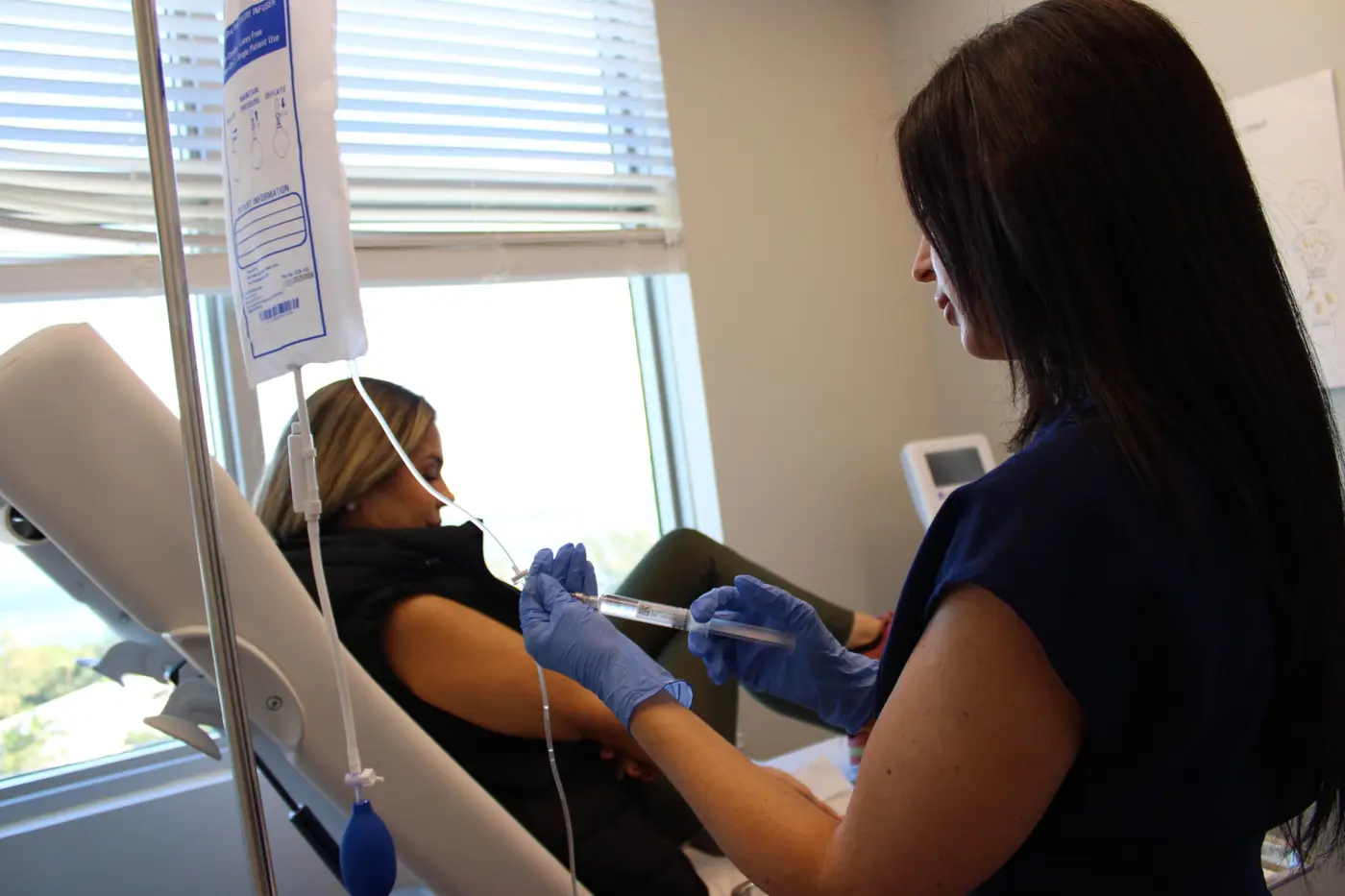
- Intravenous delivery bypasses digestion, which matters when absorption is impaired or depletion is documented.
- A randomised trial of 141 adults found reduced fatigue after a 10 g intravenous vitamin C infusion versus saline.
- The broad wellness claims made for IV drips are not supported by large randomised trials.
- The strongest use case is correcting a measured deficiency inside a medical plan — not a menu you order from.
- High-dose vitamin C is contraindicated in G6PD deficiency and used cautiously in kidney disease and oxalate stone history.
Why the route matters at all
Nutrients taken by mouth have to survive digestion. Absorption varies with gut health, gastric pH, the presence of food, competing minerals and the dose itself — and for several nutrients the absorptive mechanism saturates, so a larger oral dose simply produces a larger unabsorbed fraction. Vitamin C is the textbook case: oral dosing raises plasma levels only modestly regardless of how much you take, because uptake is transporter-limited. Intravenous administration bypasses that ceiling entirely and reaches plasma concentrations oral supplementation cannot. That is a real pharmacological difference, and it is the legitimate argument for the route.
Where it genuinely helps
Used well, IV therapy does three things credibly. It rehydrates quickly, which matters after illness, heat exposure, travel or a hard training block. It corrects documented depletion faster than oral repletion in patients with malabsorption, post-surgical states, or intake that cannot keep up. And it delivers specific nutrients at concentrations that oral routes cannot reach, where there is a clinical reason to want that. Notice the qualifier running through all three: documented, clinical, specific. The best infusion is the one chosen from your labs and history.
Where the marketing outruns the evidence
The claims attached to IV drips — immunity, detoxification, anti-ageing, hangover cures, general vitality — are not supported by large randomised trials. A review of clinical applications of intravenous vitamin therapy put it bluntly: these claims are widely publicised by celebrities and influencers and lack support from large-scale randomised controlled trials. The trials that do exist are mostly small, short, single-centre, and heterogeneous in dose and formulation. Absence of high-quality evidence is not proof that something does nothing, but it is a reason to stop selling certainty.
The fatigue question
The most-cited positive trial is worth understanding precisely, because it is frequently misrepresented. A double-blind randomised controlled trial published in Nutrition Journal gave 141 healthy office workers aged 20 to 49 either 10 grams of intravenous vitamin C or saline, and reported reduced fatigue in the treatment group two hours after infusion. That is a genuine finding in a real trial. It is also a single infusion in healthy adults with a short follow-up window, which is a considerable distance from a claim that regular drips will fix chronic fatigue.
What an infusion cannot replace
No infusion substitutes for sleep, protein intake, training, alcohol reduction, or treatment of an underlying condition. When fatigue has a cause — hypothyroidism, iron deficiency, insulin resistance, sleep apnoea, depression, medication side effects — the answer is finding it. This is the part of the conversation that distinguishes a medical practice from a drip lounge. A responsible clinician will sometimes tell you that IV therapy is the wrong tool for what you are describing, and will say what the right one is.
Safety, screening and honest risk
Infusions given by licensed clinical staff after a medical review have a good safety record. Common effects are minor: a cool sensation along the arm, a metallic taste, mild bruising, occasional lightheadedness. Less common risks include vein irritation, infiltration and allergic reaction. Screening genuinely matters: high-dose vitamin C is avoided in G6PD deficiency because of haemolysis risk, used cautiously in kidney impairment and in anyone with a history of calcium-oxalate stones, and total fluid volume needs care in heart failure. Tell your provider every medication and supplement you take. And to be explicit: IV therapy is not emergency care. If you are having chest pain or difficulty breathing, call 911.
What physician-guided actually means
It means five specific things. A medical intake before anything is ordered. Labs where they change the decision. A formula selected by a licensed provider from those results rather than from a price list. Administration and monitoring by licensed clinical staff in a clinical setting. And follow-up that asks whether it is actually working — with a willingness to stop if the answer is no. That last step is the one most commonly missing, and it is the difference between a therapy and a subscription.
Qué dice la investigación
Citamos los estudios directamente, incluyendo dónde la evidencia es limitada. Los enlaces llevan a la fuente original.
Un estudio farmacocinético reciente de la vitamina C oral mostró que las concentraciones plasmáticas de vitamina C apenas se ven afectadas por la administración oral, debido a su escasa biodisponibilidad.
Suh S-Y, et al. Intravenous vitamin C administration reduces fatigue in office workers: a double-blind randomized controlled trial. Nutrition Journal, 2012.
141 adultos sanos de 20 a 49 años asignados al azar a 10 g de vitamina C intravenosa o suero salino. La fatiga fue menor en el grupo tratado dos horas después de la infusión.
Dada la baja certeza de la evidencia, esta terapia potencialmente salvadora requiere más estudios para identificar el momento, la dosis y la duración óptimos del tratamiento.
Lee Z-Y, et al. Intravenous vitamin C monotherapy in critically ill patients: a systematic review and meta-analysis of randomized controlled trials. Annals of Intensive Care, 2023.
Incluso en cuidados intensivos, donde más se ha investigado, la dosis y el momento siguen sin estar resueltos. La vía de administración por sí sola no determina el beneficio.
Estas afirmaciones, aunque ampliamente difundidas por celebridades e influencers, carecen de respaldo de ensayos controlados aleatorizados a gran escala.
The Science Behind Intravenous Vitamin Therapy — revisión de aplicaciones clínicas.
Por eso nuestras infusiones se vinculan a una carencia medida y a un plan médico, en lugar de comercializarse como un producto de bienestar general.
Preguntas frecuentes
How long does a session take?+
Most infusions run 30 to 60 minutes in a calm, supervised room. Your first visit is longer because it is a full medical consultation.
Do I need labs before my first infusion?+
In most cases yes. Choosing a formula without knowing nutrient status, kidney function and inflammatory markers is guesswork.
Will IV therapy fix my fatigue?+
Only if depletion or dehydration is the cause. Fatigue frequently traces to thyroid disease, iron deficiency, insulin resistance, sleep apnoea or depression, and those need treating directly.
Is high-dose vitamin C safe for everyone?+
No. It is avoided in G6PD deficiency and used cautiously in kidney disease and in patients with a history of calcium-oxalate stones.
How often should I have an infusion?+
It depends on goals and labs — typically weekly to monthly, with reassessment rather than an open-ended schedule.
Can I drive afterwards?+
Almost always yes. If you feel lightheaded we keep you until it resolves.
Do you offer infusions at home?+
Yes. Concierge infusions at your home, hotel or office are available across Miami-Dade for an additional travel fee, quoted before you book. The medical standard is identical to the clinic — physician review first, licensed clinical staff administering and monitoring throughout — and your provider confirms whether your specific protocol is suitable for a mobile setting.
Is it covered by insurance?+
No. Fees are reviewed transparently in advance and superbills are provided.


Cuando su salud funciona mejor, todo funciona mejor.
Cuéntenos sus objetivos, sus desafíos y lo que más le importa: nosotros nos encargamos del resto.
Hablemos